Doors and Windows

At one time I thought of life as a series of rooms connected by doors that we travel through or windows that we look through.  I am now realizing that the analogy is better suited to a hallway than a room.

We travel through life down a short or long hallway with some number of doors and windows.  For me, right now this is a long and pretty nice hallway that I cannot see the end of and I am OK and pretty good with it.  There are doors, some hidden, some locked, some open with a hawker beckoning, and some just quietly sitting there waiting.  As I progress down this hallway, doors and the new hallways that they opened on to pass by and are no longer available because this is just a forward path.  I imagine at some point in the future, this hallway will end or the ceiling will come crashing down and I will be forced to escape through one of the doors.  I know this to be true because it has happened in the past, but for now I will just be content with this hallway and the beautiful path that it is providing.

And yet, two very interesting doors on opposite sides of the hallway are open just enough to slip my foot through.  Both open on to new, thrilling, exciting hallways of future possibility so now a choice needs to be made else it will make itself for me.

“It’s a dangerous business, Frodo, going out your door. You step onto the road, and if you don’t keep your feet, there’s no knowing where you might be swept off to.”

No regrets.  I’ll go where this road (or hallway) takes me, dangerous business or not, and continue to wander through my interesting hallway.  For the next little bit, I think I will enjoy the walk and stop pausing to look through windows.

“All that is gold does not glitter,
Not all those who wander are lost;
The old that is strong does not wither,
Deep roots are not reached by the frost.”


ancient arch architecture art
Photo by Pixabay on Pexels.com

Disjointed, Disconnected, and Spinning

One month in to the Spring Semester and things feel much like bald tires in trying to gain some traction in quicksand.  Two new classes that only meet twice a week but met only three times in the first three weeks make it hard to develop any flow or continuity.  Over the same 4 week (20 school day) period, public schools have only met 9 times with 11 snow days.  While I love “Take your daughter to work day,” they make it difficult to develop a rhythm and get things done.

On the eve of the first test, I am left wondering …

… but still optimistic.  Things will improve, things will get better.

Rear View Mirrors

Some views are much better when framed by a rear view mirror.  The experience was either palatable or just not horrible (not the same thing) with lessons learned and knowledge gained but with little or no desire to repeat.

Other views are much better when framed by the windshield, preferably of a rag-top, traveling at a sufficiently high rate of speed.  Pregnant with possibility and full of eager anticipation, both for the “joie de vivre” inherent in the experience and for life’s lesson learned (or about to be).

Nice to have both views juxtaposed and constantly in view, just to safegaurd against a loss of perspective.

camera camera lens capture car
Photo by Martijn Adegeest on Pexels.com

Engaged and Connected

In nearly 30 years of teaching this has been the most difficult semester I have ever experienced

.  I have never really felt engagement with the class and that is truly odd for me.  Much effort and time have been spent at the sub-conscious level trying to understand why, recognizing that it has likely been mutual and significantly counter-productive.  A variety of plausible explanations have come up, none of which is truly testable.

With growing relief and regret, the lack of engagement seems to be getting remediation.  It is sad that there are only 2 1/2 weeks left to salvage.  The lone bright spot is that it has been a learning experience.  I now have plans, going forward, to try and remedy this in the future and perhaps avoid it altogether.

Life’s lessons learned.

red and three blue jigsaw puzzles
Photo by rawpixel.com on Pexels.com

Assumptions and Appropriate Behavior

“Sorry for the late e-mail it slipped my mind to ask, I was wondering when would be a good time for me to make up my Exam?”

Sometimes it is difficult to come up with a simple, clear, concise response that is not mean or ill-spirited but yet still conveys the appropriate information while dispelling the obvious assumptions and activities that the question indicates.

The exam was more than 10 days ago.  The syllabus indicates that there are no make-up exams except in rare, unusual circumstances that have not been indicated nor discussed.  Making up the exam is irrelevant because passing the course is no longer possible because you have missed 4 of the 8 labs we have done so far.

Coverage

In a sequenced, 2-semester general chemistry class, how should one best determine coverage, both which topics to cover and how beep to cover those topics?  Which topics to cover is usually established when the course is originally designed and proposed but often is established in such a way as to be sufficiently vague that almost anything in reason is allowable.  An example might be “Spend 5 days (almost 1 1/2 weeks) on Stoichiometry.  Include balancing equations, moles relationships and mole-mass conversions, percent yield, and limiting reagents.”

As the course has a pre-requisite of previous chemistry where all of these topics should have been covered in some fashion, adequate coverage can likely be accomplished in a day or two.  That leaves roughly 3 hours of instruction time to the discretion of the instructor.  Should that instructor do more simple examples that might bore the really good students in hopes of salvaging some of the really poor students, or should they expand deeper but still on-topic down roads that interest them, or down roads that likely interest the students, or down roads that the students are more likely to encounter in their future courses and careers?  Not only is each instructor of this course going to place very different merit and worth on each of these four possibilities, but for every instructor, each of these four paths will look quite different then they would to the next instructor.  How then, can we (or should we) do a better job of making sure that students completing the first semester of a sequenced course have uniform or even similar preparation when moving second semester?

flat lay photography of calendar
Photo by rawpixel.com on Pexels.com

Schedule Planning

We plan our course, scheduling exams, quizzes, homework deadlines, and … and we do all this 3-6 months in advance.  We try to integrate the experience with a lab schedule where different sections of the same lab might be separated by as much as 3 hours worth of lecture.  We also have to accommodate external constraints such as midterm grade reporting and holidays that mean some labs meet that week and some labs don’t but yet are must still have the “same academic experience” and meet the “same outcomes.”

Is it any wonder that, after 7 weeks (roughly 23 hours of lecture), I am off by about 5% (which equates to one full day of lecture) and have a day with nothing to do but extra review for the coming exam.  If I start the new material that comes after the exam, nobody will pay attention because they are focused on the immediate concern of this exam.  If I move the exam up a day, those who have been procrastinating will be in a world of hurt and the previously established homework deadlines won’t match up to prepare them for the test.

Interesting new thought here.  Unscheduled tests.  We will have a test when we finish this material.  You must remain current with material because you will only get 48 hours notice of when the exam is about to occur.

people coffee meeting team
Photo by Startup Stock Photos on Pexels.com

Pace

A college chemistry course, part of a two-semester sequence in general chemistry, that has a specified prerequisite of a year of high school chemistry and intermediate algebra.  How to establish an appropriate pace for coverage of the material/  So many different things go into the equation that determines this including but not limited to:  1)  we meet 4 days per week.  2)  we have a specified list of topics we are expected to cover and outcomes we are expected to achieve.  3)  students always want more examples of how to do the problems.  4)  students often don’t read the book or do any of the problems before they come to class.  5)  a year of high school chemistry or a semester of high school level chemistry in college means a wide variation in terms of level of preparation.  6)  passing the prerequisite course with a C- or better means the student possibly had no understanding on approximately 30% of the material.

End result – It is very hard to hit a good pace that allows the struggling students to work extra and catch up while still keeping the really good students engaged and interested.  It is much easier in the second semester of the course because some filtering has occurred and the level of preparation has become more uniform.  At this level, however, it becomes a difficult juggle.  Too many examples and the good students start to disengage.  To few examples and we start to go through the material faster and then we end up hitting more than one significant new concept in a 50 minute lecture and the second one gets lost in the shuffle by those who are struggling.  How to incorporate stall tactics into a lecture without having them be obvious stall tactics so that good students will remain engaged and weaker students will not be hurt or hindered by the content of what is being talked about during the stall?

photo of father and daughter running at the park
Photo by Josh Willink on Pexels.com

Chess Traps, Pitfalls, & Swindles

Just started what is likely to be the most difficult (based on recent assessment data) section of the general chemistry course this semester, Thermochemistry.  While it may bot be full of swindles, there are certainly enough traps and pitfalls to go around.  This brings up the challenging question of the week.  When we know the road ahead is full of traps and pitfalls, how do we best prepare our students to traverse this dangerous path.

We can’t just spring the traps and fill in the pits.  This would leave them unprepared for dealing with similar issues on the road ahead.  they need to be able to identify the problems at hand and solve them, and giving them similar, simpler problems will make them feel better, and they will survive the journey, and they will like us more, but at what potential cost.

If they just follow us through the mine field, they will still cross safely but be unable to negotiate future fields on their own.  They will develop a false sense of security and, in the end, get eaten by a lion or something.

Maybe we just need to tell them it is a really, really, really dangerous road and walk beside, or slightly behind, them and guide with suggestive questions and mild suggestions along the way.  But dang, it is hard to do that with 85 different travelers all at the same time.

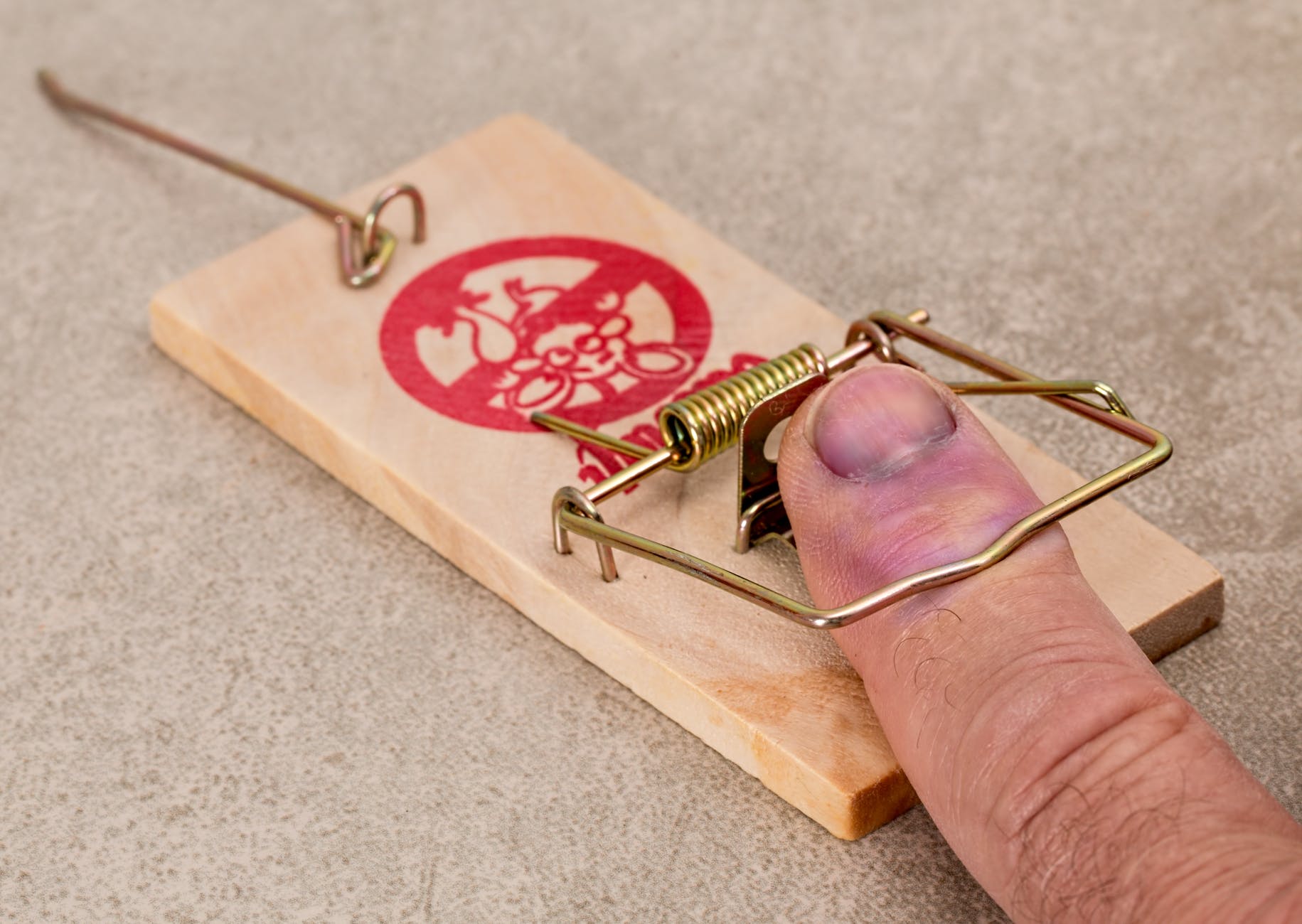
close up finger hurt pain
Photo by Pixabay on Pexels.com

Engagement and Conceptual Frameworks

Chemistry is rather abstract and can be difficult to latch on to and warp one’s head around, conceptually.  I benefited from a brilliant instructor when I started out because he frequently did demonstrations (or his lab assistant did them) that kept us engaged or entertained or attentive or …  I try to do something similar by incorporating analogies and real world, practical, everyday examples of the concepts we are discussing.  I really enjoy doing this with gases because there are so many practical examples that most people don’t think or know about.  Late this week, when talking about Kinetic Molecular Theory and Effusion and Diffusion of gases, we were rich with examples including skunks, perfume, leak analysis and natural gas, Heineken,  and the Manhattan Project and isotope enrichment.

I noticed that several students (those over-achievers that inhabit the first or second row of the lecture hall) starting to look bored and complaining to each other that we were taking too long on this topic, which they apparently already knew well enough through memorized formulas, and wishing that we would please move on which we eventually did.  After class, other students (from somewhere in the back of the lecture hall) came up and indicated that the examples really helped and that the lecture material was finally starting to stick and make sense.

Balance.